
New Zero-Shot Learning Approach Advances Maize Phenotyping and Yield Estimation Without Model Retraining
A new study published in Smart Agricultural Technology introduces a zero-shot learning (ZSL) framework for maize cob phenotyping. This innovative pipeline enables accurate extraction of geometric traits and yield estimation in both laboratory and field environments without the need for model retraining.
The study was led by Associate Professor ZHANG Miao and Professor WU Bingfang of the Aerospace Information Research Institute, Chinese Academy of Sciences (AIRCAS), in collaboration with Hubei University, the University of Queensland, and the Institute of Agricultural Resources and Regional Planning, Chinese Academy of Agricultural Sciences.
Maize cob geometric traits are critical for breeding programs and yield estimation. However, traditional phenotyping methods remain labor-intensive, costly, and lack scalability required for modern agriculture. Existing deep learning approaches often require model retraining or parameter adjustments for new varieties or environments, creating barriers for non-experts, resource-limited users, and field applications.
To address these challenges, the researchers developed a zero-shot learning framework that combines a text-guided object detection model (Grounding DINO), lightweight image segmentation, and calibrated extraction of geometric traits. By leveraging textual prompts and semantic embeddings, the framework offers a scalable, cost-effective alternative to labor-intensive manual measurements and data-intensive supervised models. It demonstrates robust performance across laboratory and field datasets spanning diverse genotypes and ecogeographical regions.
The results highlight the framework's efficacy, achieving highly accurate detection (98–100% accuracy), segmentation (99.6% AP), and trait estimation (r > 0.95 for key metrics), while enabling rapid yield prediction (R² up to 0.93).
The study emphasizes three major advancements of this new approach. It shows strong generalization capability, allowing the framework to be applied to corn varieties with different genotypes and across diverse ecological and geographical environments without retraining. It also works with images taken by everyday devices such as smartphones and document scanners, enabling in situ data collection under varying lighting conditions, and removing the need for strictly controlled environments. In addition, the lightweight design significantly reduces computational demands, facilitating real-time trait calculation and deployment on edge devices.
This fully zero-shot pipeline effectively bridges the gap between precise laboratory measurements and large-scale field applications. The results provide an efficient phenotyping tool for maize breeding but also offer vital technical support for yield prediction and precision agriculture management. By adjusting prompts and parameters, the framework can also be adapted for phenotypic analysis of other crops.
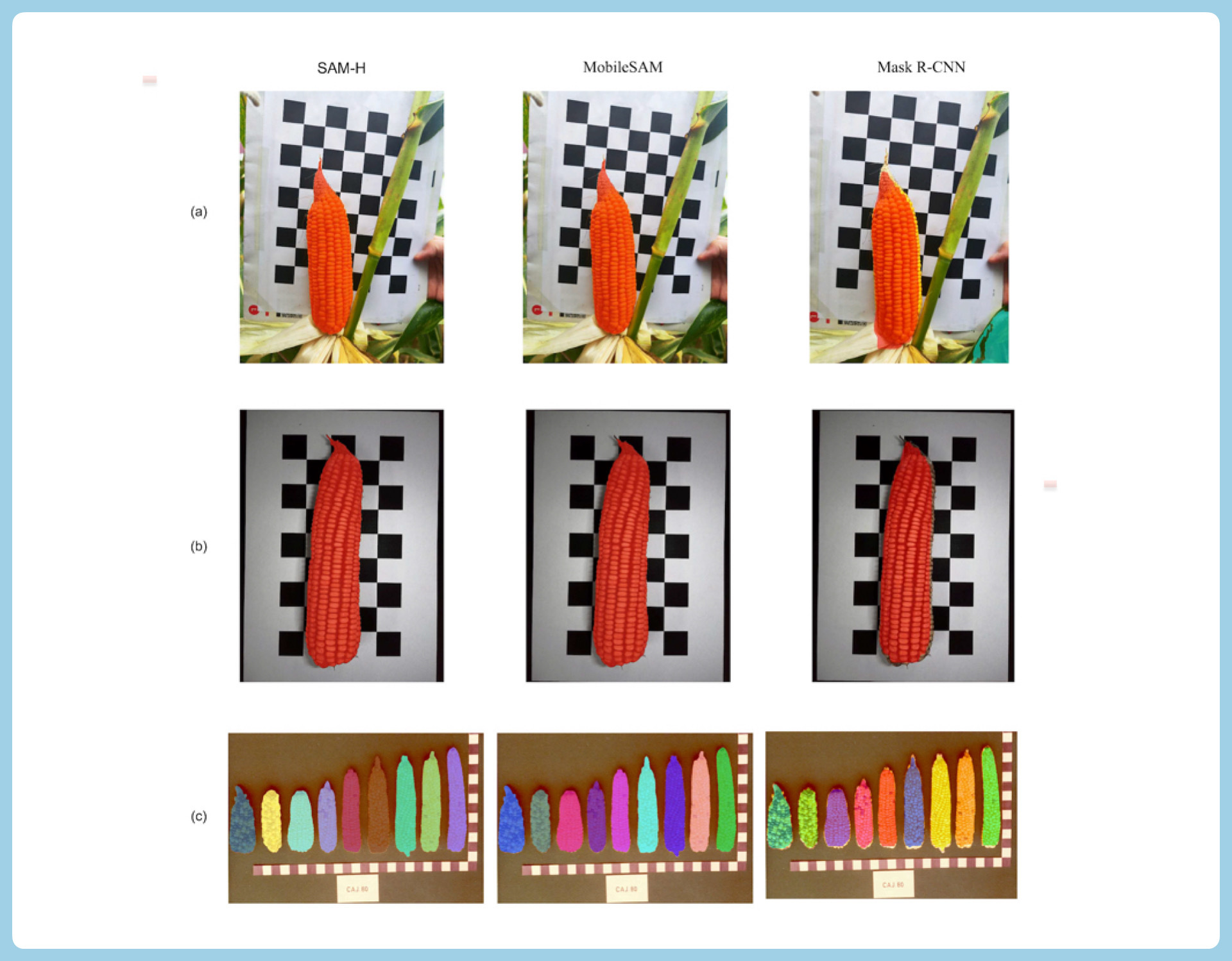
Instance segmentation of maize cobs using SAM-H (left), MobileSAM (middle), and Mask R-CNN (right) from different image datasets. (a) Guantao field, (b) Guantao lab, (c) Peruvian lab. (Image by AIRCAS)


News & Events